
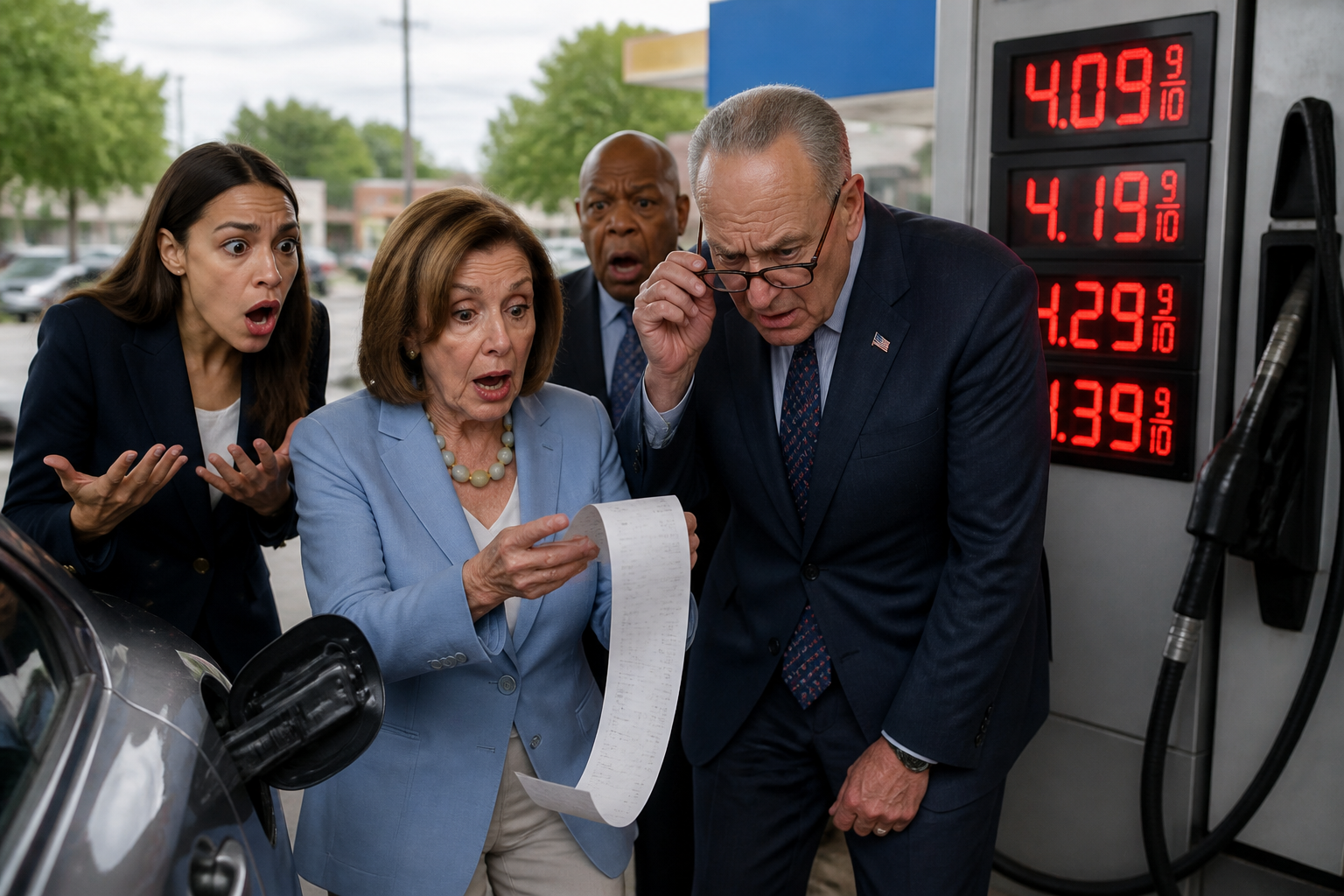
WASHINGTON — In a remarkable advance for political science, Democrats have discovered that four-dollar gasoline is a matter of urgent national concern, a finding that arrived on schedule with a Republican in the White House.
The discovery was documented by Reuters, which noted that Democratic candidates have begun deploying against the Trump administration the exact same line of attack Republicans once wielded against Joe Biden with great enthusiasm.
During the Biden presidency, gasoline prices surged following Russia's invasion of Ukraine and the resulting disruptions to global energy markets. At the time, Republicans identified the cause of the surge with unusual precision, locating it entirely inside the White House. Gas stations served as the party's preferred campaign backdrop, where candidates presented the price on the pump as a direct referendum on Democratic energy policy and economic management and as evidence that everyday households were paying the price for decisions made in Washington.
Now in 2026, with Donald Trump back in the White House, the mechanics of the energy market have been updated. Republicans have found themselves on the receiving end of the same argument, as rising gasoline prices complicate the party's affordability message and Democrats argue voters should now hold the Republican administration responsible for the cost of filling up.
Economists continue to maintain, inconveniently, that presidents do not directly set gasoline prices, which are shaped instead by global crude-oil markets, refinery capacity, geopolitical conflicts, seasonal demand, taxes, distribution costs and government policy, among other unhelpful complexities. Both parties have historically shown a bipartisan ability to overlook that detail whenever blame becomes politically useful.
According to the new consensus, presidential control over gasoline prices appears to function on a highly sophisticated partisan sensor, activating only when the opposing party holds the presidency and entering a dormant, market-driven phase when allies are in charge. Researchers expect the principle to reverse again without incident at the next change of administration.