
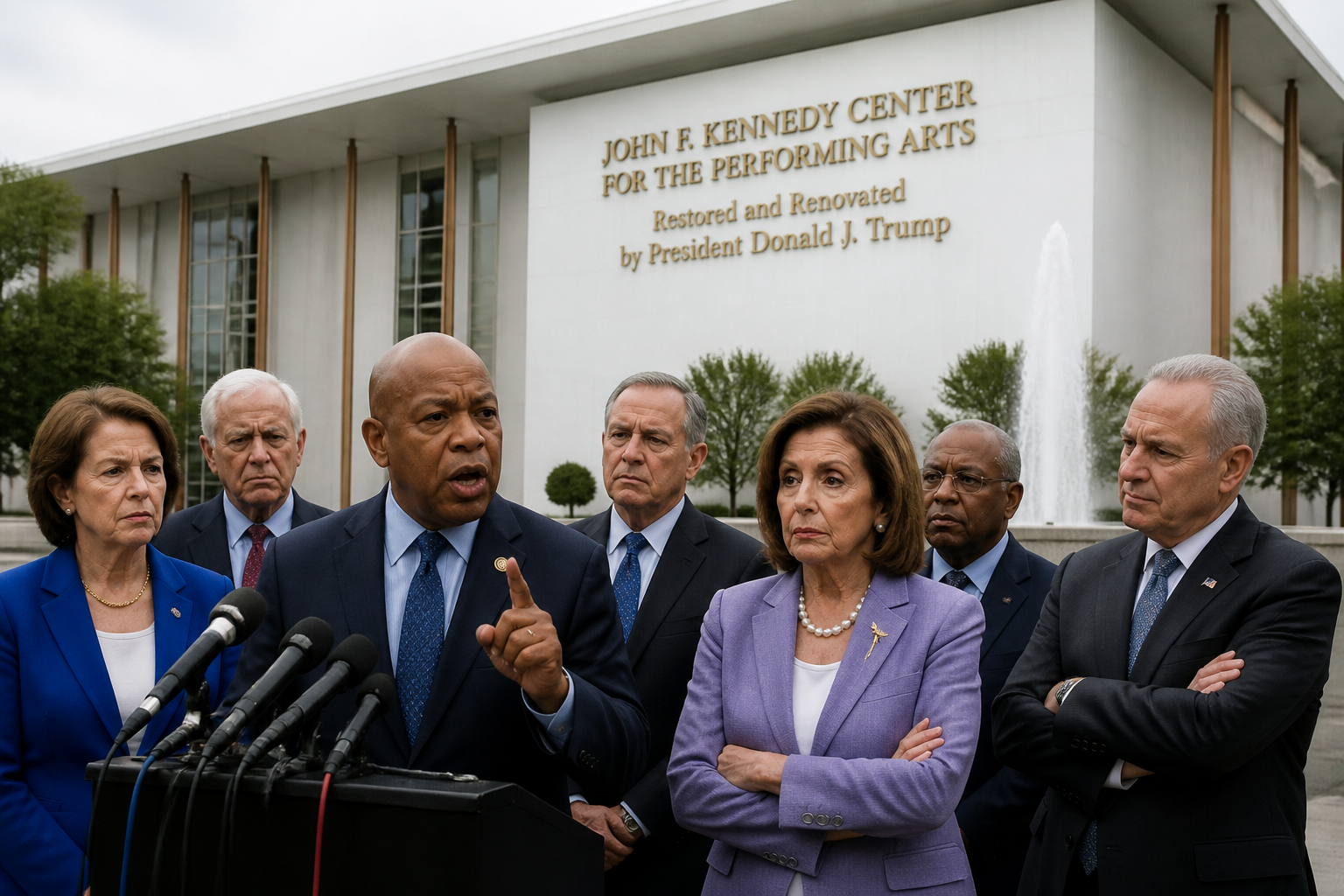
WASHINGTON — Democrats announced this week that they are staunchly opposed to the practice of naming prominent Washington buildings after politicians, speaking from directly beneath the signage of a prominent Washington building named after a politician.
The objection follows an August 2026 vote by the Kennedy Center's board to add President Donald Trump's name to the institution in connection with restoration and renovation work. Under the approved plan, the center would not simply discard its existing identity as the John F. Kennedy Center for the Performing Arts. Instead, the building would retain the Kennedy name while adding an inscription crediting Trump with the restoration and renovation, with the physical plaza also designated in his name.
Democratic critics denounced the proposal as an effort to politicize a major national cultural institution and to attach a personal brand to a venue established as a memorial to President John F. Kennedy, warning that the performing arts center should not be turned into a monument to political vanity.
The debate arrives after a previous, more ambitious attempt to attach Trump's name to the Kennedy Center collapsed under legal scrutiny. A federal judge ruled that formally changing the institution's statutory name required an act of Congress, after which Trump's name was removed, prompting the board to pursue the more modest approach of a renovation inscription and a plaza designation rather than a wholesale renaming.
For critics, the distinction between a statutory renaming, an honorific inscription, and a plaza dedication represented an alarming escalation in the politicization of culture, distinct from the longstanding tradition of naming the entire institution, its purpose, and its national identity after a former president.
Observers noted the party's newfound concern marked a refreshing embrace of architectural neutrality, with several lawmakers reportedly urging that all future memorials, libraries, and centers be named after apolitical figures such as trees or geological formations to avoid further confusion.